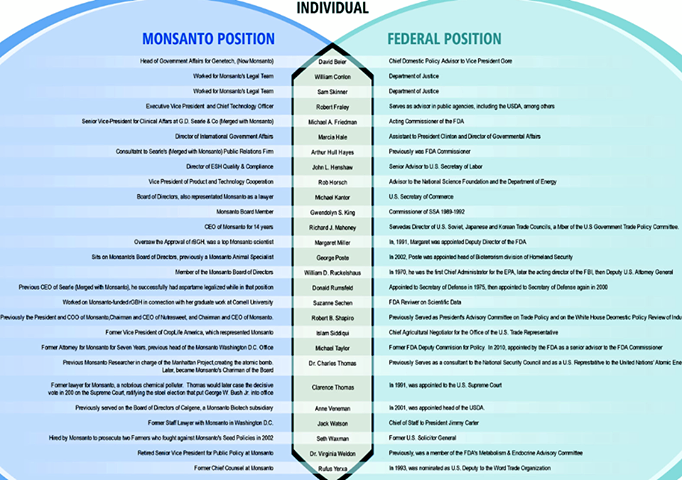
Posted May 29,2013. Important article below. I’ve talked a lot about GMO foods. But it’s time to take this seriously. Most countries other than the US do not allow GMO foods. The US does. If you have Lyme symptoms and Lyme disease, stop all GMO foods. They will seriously impair your ability to heal. And before you read the article, take a peek at the folks involved with genetically modified foods. Be sure to read the article too, it’s a very good, clear explanation of what genetically modified foods are.
Genetically Modified Foods
According to the World Health Organization, Genetically Modified Organisms(GMOs) are “organisms in which the genetic material (DNA) has been altered in such a way that does not occur naturally.”1 This technology is also referred to as “genetic engineering”, “biotechnology” or “recombinant DNA technology” and consists of randomly inserting genetic fragments of DNA from one organism to another, usually from a different species. For example, an artificial combination of genes that includes a gene to produce the pesticide Cry1Ab protein (commonly known as Bt toxin), originally found in Bacillus thuringiensis, is inserted in to the DNA of corn randomly. Both the location of the transferred gene sequence in the corn DNA and the consequences of the insertion differ with each insertion. The plant cells that have taken up the inserted gene are then grown in a lab using tissue culture and/or nutrient medium that allows them to develop into plants that are used to grow GM food crops.2
Natural breeding processes have been safely utilized for the past several thousand years. In contrast, “GE crop technology abrogates natural reproductive processes, selection occurs at the single cell level, the procedure is highly mutagenic and routinely breeches genera barriers, and the technique has only been used commercially for 10 years.”3
Despite these differences, safety assessment of GM foods has been based on the idea of “substantial equivalence” such that “if a new food is found to be substantially equivalent in composition and nutritional characteristics to an existing food, it can be regarded as safe as the conventional food.”4 However, several animal studies indicate serious health risks associated with GM food consumption including infertility, immune dysregulation, accelerated aging, dysregulation of genes associated with cholesterol synthesis, insulin regulation, cell signaling, and protein formation, and changes in the liver, kidney, spleen and gastrointestinal system.
There is more than a casual association between GM foods and adverse health effects. There is causation as defined by Hill’s Criteria in the areas of strength of association, consistency, specificity, biological gradient, and biological plausibility.5 The strength of association and consistency between GM foods and disease is confirmed in several animal studies.2,6,7,8,9,10,11
Specificity of the association of GM foods and specific disease processes is also supported. Multiple animal studies show significant immune dysregulation, including upregulation of cytokines associated with asthma, allergy, and inflammation. 6,11 Animal studies also show altered structure and function of the liver, including altered lipid and carbohydrate metabolism as well as cellular changes that could lead to accelerated aging and possibly lead to the accumulation of reactive oxygen species (ROS). 7,8,10 Changes in the kidney, pancreas and spleen have also been documented. 6,8,10 A recent 2008 study links GM corn with infertility, showing a significant decrease in offspring over time and significantly lower litter weight in mice fed GM corn.8 This study also found that over 400 genes were found to be expressed differently in the mice fed GM corn. These are genes known to control protein synthesis and modification, cell signaling, cholesterol synthesis, and insulin regulation. Studies also show intestinal damage in animals fed GM foods, including proliferative cell growth9 and disruption of the intestinal immune system.6
Regarding biological gradient, one study, done by Kroghsbo, et al., has shown that rats fed transgenic Bt rice trended to a dose related response for Bt specific IgA. 11
Also, because of the mounting data, it is biologically plausible for Genetically Modified Foods to cause adverse health effects in humans.
In spite of this risk, the biotechnology industry claims that GM foods can feed the world through production of higher crop yields. However, a recent report by the Union of Concerned Scientists reviewed 12 academic studies and indicates otherwise: “The several thousand field trials over the last 20 years for genes aimed at increasing operational or intrinsic yield (of crops) indicate a significant undertaking. Yet none of these field trials have resulted in increased yield in commercialized major food/feed crops, with the exception of Bt corn.”12However, it was further stated that this increase is largely due to traditional breeding improvements.
Therefore, because GM foods pose a serious health risk in the areas of toxicology, allergy and immune function, reproductive health, and metabolic, physiologic and genetic health and are without benefit, the AAEM believes that it is imperative to adopt the precautionary principle, which is one of the main regulatory tools of the European Union environmental and health policy and serves as a foundation for several international agreements.13 The most commonly used definition is from the 1992 Rio Declaration that states: “In order to protect the environment, the precautionary approach shall be widely applied by States according to their capabilities. Where there are threats of serious or irreversible damage, lack of full scientific certainty shall not be used as a reason for postponing cost-effective measures to prevent environmental degradation.”13
Another often used definition originated from an environmental meeting in the United States in 1998 stating: “When an activity raises threats to the environment or human health, precautionary measures should be taken, even if some cause and effect relationships are not fully established scientifically. In this context, the proponent of an activity, rather than the public, should bear the burden of proof (of the safety of the activity).”13
With the precautionary principle in mind, because GM foods have not been properly tested for human consumption, and because there is ample evidence of probable harm, the AAEM asks:
- Physicians to educate their patients, the medical community, and the public to avoid GM foods when possible and provide educational materials concerning GM foods and health risks.
- Physicians to consider the possible role of GM foods in the disease processes of the patients they treat and to document any changes in patient health when changing from GM food to non-GM food.
- Our members, the medical community, and the independent scientific community to gather case studies potentially related to GM food consumption and health effects, begin epidemiological research to investigate the role of GM foods on human health, and conduct safe methods of determining the effect of GM foods on human health.
- For a moratorium on GM food, implementation of immediate long term independent safety testing, and labeling of GM foods, which is necessary for the health and safety of consumers.
(This statement was reviewed and approved by the Executive Committee of the American Academy of Environmental Medicine on May 8, 2009.)
Submitted by Amy Dean, D.O. and Jennifer Armstrong, M.D.
Bibliography: Genetically Modified Foods Position Paper AAEM
- World Health Organization. (Internet).(2002). Foods derived from modern technology: 20 questions on genetically modified foods. Available from: http://www.who.int/foodsafety/publications/biotech/20questions/en/index.php
- Smith, JM. Genetic Roulette. Fairfield: Yes Books.2007. p.10
- Freese W, Schubert D. Safety testing and regulation of genetically engineered foods. Biotechnology and Genetic Engineering Reviews. Nov 2004. 21.
- Society of Toxicology. The safety of genetically modified foods produced through biotechnology. Toxicol. Sci. 2003; 71:2-8.
- Hill, AB. The environment and disease: association or causation? Proceeding of the Royal Society of Medicine 1965; 58:295-300.
- Finamore A, Roselli M, Britti S, et al. Intestinal and peripheral immune response to MON 810 maize ingestion in weaning and old mice. J Agric. Food Chem. 2008; 56(23):11533-11539.
- Malatesta M, Boraldi F, Annovi G, et al. A long-term study on female mice fed on a genetically modified soybean:effects on liver ageing. Histochem Cell Biol. 2008; 130:967-977.
- Velimirov A, Binter C, Zentek J. Biological effects of transgenic maize NK603xMON810 fed in long term reproduction studies in mice. Report-Federal Ministry of Health, Family and Youth. 2008.
- Ewen S, Pustzai A. Effects of diets containing genetically modified potatoes expressing Galanthus nivalis lectin on rat small intestine.Lancet. 354:1353-1354.
- Kilic A, Aday M. A three generational study with genetically modified Bt corn in rats: biochemical and histopathological investigation. Food Chem. Toxicol. 2008; 46(3):1164-1170.
- Kroghsbo S, Madsen C, Poulsen M, et al. Immunotoxicological studies of genetically modified rice expression PHA-E lectin or Bt toxin in Wistar rats. Toxicology. 2008; 245:24-34.
- Gurain-Sherman,D. 2009. Failure to yield: evaluating the performance of genetically engineered crops. Cambridge (MA): Union of Concerned Scientists.
- Lofstedt R. The precautionary principle: risk, regulation and politics. Merton College, Oxford. 2002.
From the American Academy of Environmental Medicine